Redford Water Damage Restoration › Basement flooding
What to Do About Basement Flooding in Redford Township
By our Redford Township team at Redford Water Damage Restoration
Basement water in Redford Township comes from a few places: the sewer, the sump, groundwater and storm runoff. Here is what the public record says about Redford Township.
Redford Township's typical response time is under 30 minutes. The on-call crew rolls out as soon as your call comes in.
Our written guarantee applies to every job: we fix it, we don't refund it.
Local HQ
Redford Township calls are dispatched from 25375-25495 Grand River Ave, Redford, MI 48240, Ste 25369 (Shoppes at Redford Oaks), our local office. The Local Headquarters sits on Grand River Avenue inside the Shoppes at Redford Oaks, Redford Township's main retail strip, so most calls in the township are a short drive from the door.
For Redford Township homes: Redford Township Storm, Flood and Sewer Backup Guide
Emergency Steps for Homeowners
- Do not touch switches, sockets, or cords while you stand in a wet spot.
- At a dry panel, throw the main switch to cut all basement power.
- Let the plumbing rest. No bathing, no running faucets.
- Do not start any machine that sends liquid down a drain.
- Collect proof: video, photos, and a quick list of damaged items.
- Rising sewage means one call to your utility, and one call to a cleanup crew.
Reading the Record on Water in Redford Township
Local Sewer and Drainage
The Township's own Water and Sewer Department runs the system. It maintains about 1,020,000 feet of water mains and 850,000 feet of sewer lines, one combined sewer overflow basin and nine combined sewer overflows. (Redford Township, Water & Sewer Department page)
The department reads and services about 21,000 residential and commercial water meters. (Redford Township, Water & Sewer Department page)
A resident with a basement backup calls the Water Department at 313-387-2670 during business hours. After hours, the resident calls the Township Police Department, which calls out the water foreman. (Redford Township, FAQ: Water & Sewer)
The Township asks for a written claim at 12200 Beech Daly within 45 days of finding the backup. (Redford Township, FAQ: Water & Sewer)
The Township says a claim is viable only when the municipal sewer caused the problem. Trouble in the home plumbing or the private sewer lead stays with the owner. (Redford Township, FAQ: Water & Sewer)
Redford holds a permit for one Township-owned combined sewer outfall, 45A at Woodbine and Orangelawn. It can discharge diluted combined sewage into the Rouge River system in heavy rain. (Redford Township, CSO Public Notification Plan (updated June...)
Wayne County, not the Township, runs the Redford North CSO Basin and handles notice for the other combined outfalls in Redford. (Redford Township, CSO Public Notification Plan (updated June...)
The Township must email state agencies within 4 hours of learning that outfall 45A is discharging. (Redford Township, CSO Public Notification Plan (updated June...)
A University of Michigan study lists a Wayne County-Redford CSO retention treatment basin with a median yearly discharge volume. The long-term figure (2005-2016) is 4.6 million gallons. (University of Michigan Graham Sustainability Institute,...)
The Township's one permitted combined sewer outfall, 45A, drains 385 acres of the 669 acres in Redford's combined-sewer basin. The Township does not meter 45A and estimates its overflow by that acreage ratio. (Redford Township, CSO Public Notification Plan (updated June...)
No warning sign stands at outfall 45A because fencing and private properties line both sides of the stream. (Redford Township, CSO Public Notification Plan (updated June...)
The Township's combined sewer overflow basin sits at Puritan and Lola Drive. (Redford Township, Water & Sewer Department page)
The University of Michigan factsheet counts an average 2.9 overflow events a year at the Redford retention basin from 2005 to 2016, with a peak of 10 in 2011, the year of the May 2011 floods. (University of Michigan Graham Sustainability Institute,...)
The Township's stormwater plan maps six discharge points, RF01 to RF06, along the Smith Drain, Tarabusi Creek and the Upper Rouge River. (Redford Township, 2018 Stormwater Management Plan (SWMP),...)
Usual Suspects Behind a Wet Basement
- A collapsed or offset section of the home's drain line traps waste.
- Basement window wells fill up when gutters dump runoff beside them.
- Downpours overwhelm the shared sewer, and flow returns up the lateral.
- Roots clog sewer pipes slowly, then a storm finishes the job.
- A tripped breaker or outage stops the sump pump.
- Ground saturation drives groundwater into wall pores and floor joints.
- Cracks in the footing or walls leak after snowmelt or storms.
Early Symptoms Inside the House
- Slow drains throughout the lower level, plus gurgling.
- Murky fluid seeps from the drain in the floor.
- Strong odors that smell like waste.
- White crust or dampness on the foot of the wall.
- Carpet edges that feel wet or look darker.
- Air that feels thick, with condensation on pipes.
About Category 3 Water
Contaminated water gets a special name: category 3. It may hold waste, bacteria, viruses, and mold spores. Because you cannot tell what is in it by sight, the crew assumes the worst and uses strict cleanup steps. Anything porous that absorbed it generally goes in the trash, while solid surfaces are scrubbed and treated.
Walking Through the Job
| Move | Details |
|---|---|
| Safety survey | Workers inspect for shock hazards, gas, and structural weakness. They treat any sewage exposure with extra care, choose protective suits, and talk through the plan with you before moving on. |
| Contain and classify | Before moving anything, the team identifies the source and gives the water a grade, from clean up to black. Plastic barriers and sealed entries limit the spread of contaminants to rooms that stayed dry. |
| Water extraction | Extractors pull water from slabs, carpet, and corners. Large volumes go out through hoses to an approved drain or outdoors, and the crew rechecks the room until no free water remains. |
| Strip out porous materials | Materials that wick and hold water, like carpet cushion, fiberboard, and insulation, usually cannot be saved after sewage contact. Techs remove them, label what they take, and photograph the scope for your file. |
| Detail cleaning | Hard surfaces get a thorough wash, then a disinfectant is applied as its label directs. Crews let it sit for the label contact time before wiping, so it can work as intended. |
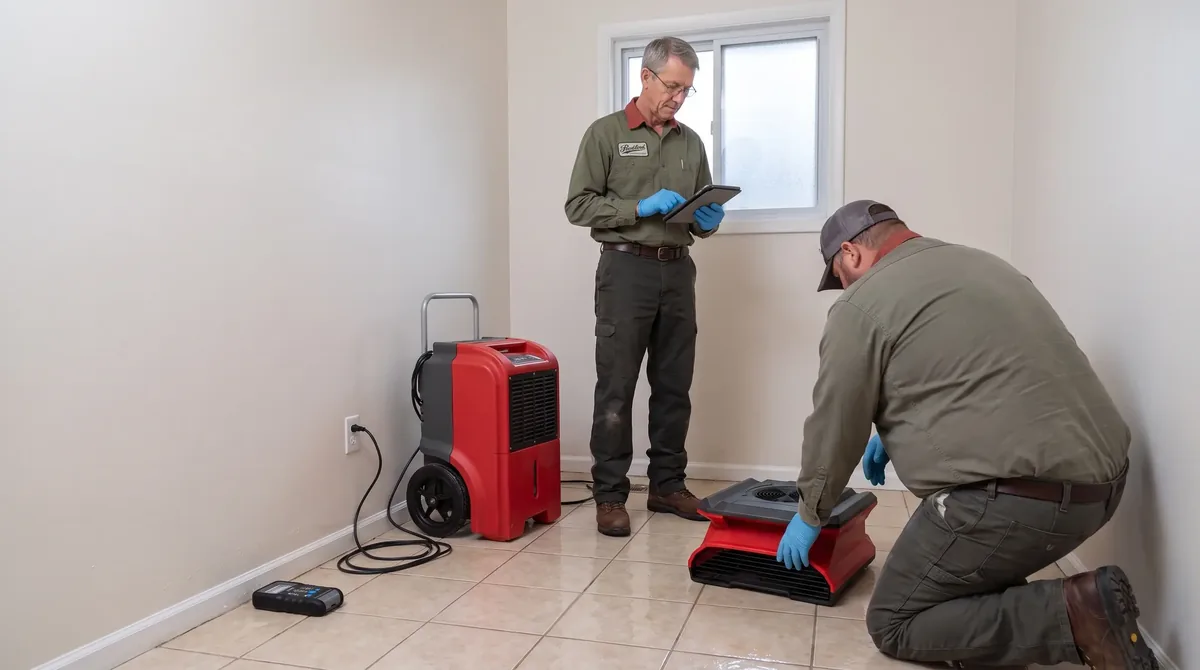
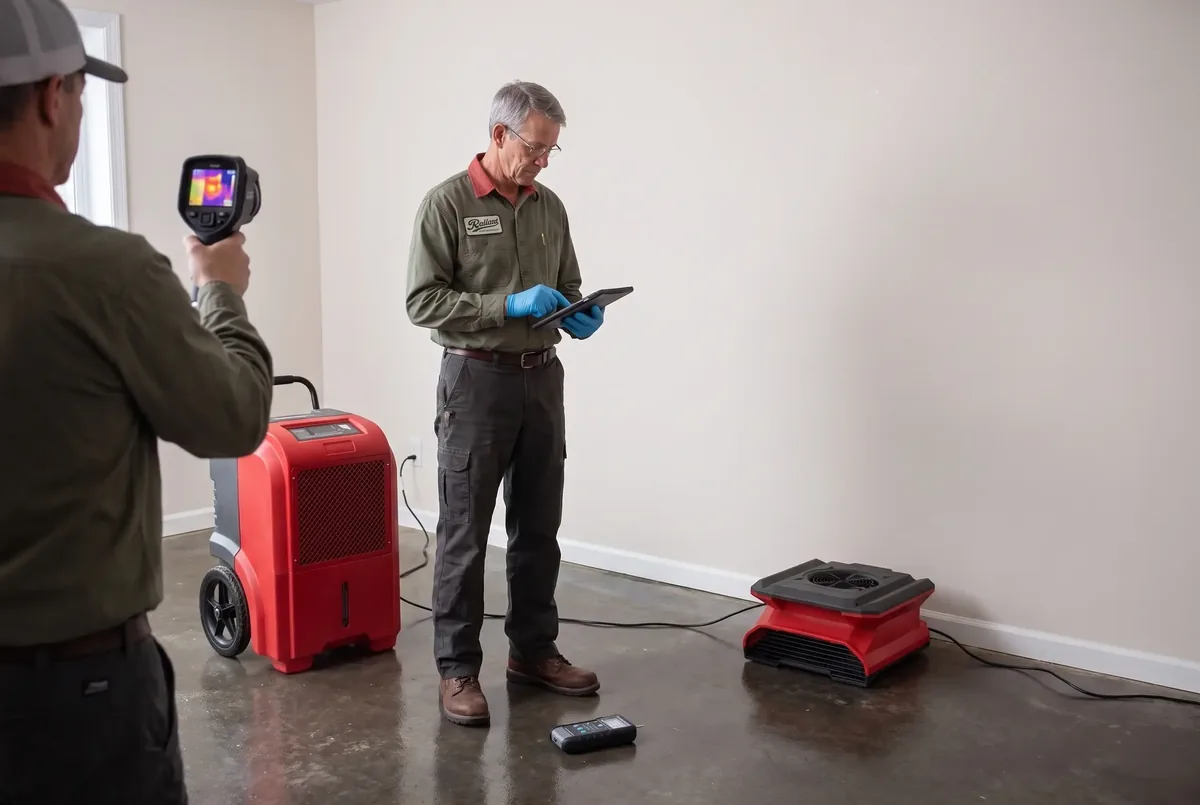
| Structural drying | Air movement and dehumidification pull moisture from framing and concrete. The crew records readings during several visits and removes equipment once measurements fall into the normal range. |
From Call to Crew at the Door
A short phone interview comes first. Then technicians come to the house, bring equipment, and start with safety checks. You may notice plastic barriers, hoses, and pumps appear. This is normal. Crew members tell you what each machine does and which rooms to avoid while the work goes on.
Questions people ask
How serious is sewage exposure?
It is serious. Sewage contains organisms that cause gastrointestinal illness and infections. Skin contact, splashes, and contaminated dust all matter. Keep out, shut doors to the area, and use protective gear if you must go in.
Can I count on insurance to pay?
You cannot count on it before checking. Coverage turns on your policy and on whether it lists sewer protection. Read the policy, then talk with your agent. Keep photos, notes, and receipts organized for the conversation.
Who hears from me first, public works or a cleaning crew?
Contact the city once waste rises through a drain, because the public line may have a blockage. Also bring a cleanup crew into it, since the work should not wait for the source repair. Either call can come first, and neither one replaces the other.
Do I need a professional, or can I do it?
A professional is the safer choice for sewage. Crews bring pumps, protective gear, disinfectants, and moisture meters. They also remove wet materials safely. Home tools rarely reach the moisture trapped behind walls. Pros also decide which items to take out.
What do plumbers suggest to prevent repeat backups?
A licensed plumber may suggest a valve against backflow, a camera check of the line, and root cutting. For groundwater, the answer might be a better sump setup, battery backup, and improved drainage around the home.
What facts exist on sewer backups for Redford Township?
The Township's own Water and Sewer Department runs the system. It maintains about 1,020,000 feet of water mains and 850,000 feet of sewer lines, one combined sewer overflow basin and nine combined sewer overflows.
Has water reached your Redford Township basement?
Call (313) 855-3932, 24/7.
Redford Township's typical response time is under 30 minutes. The on-call crew rolls out as soon as your call comes in.
The estimate, on-site, is free every time.
Our written guarantee applies to every job: we fix it, we don't refund it.